
Host Guides
How to Start a Home Poker Night People Come Back To
Build a better recurring poker night with clear expectations, intentional invitations, reliable RSVPs, host approvals, and protected address sharing.
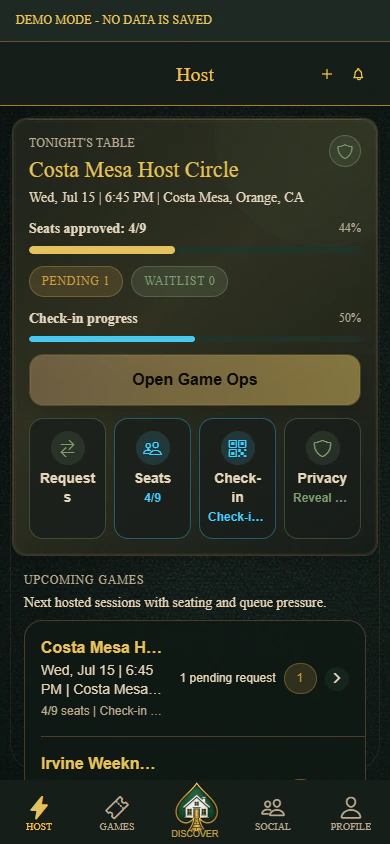
A good home poker night is not defined by how many people receive the invitation. It is defined by whether the right people understand the plan, show up, respect the home, and want to return.
These steps focus on the coordination and hospitality that make a recurring table sustainable.
1. Decide what kind of night you are hosting
Write down the basics before inviting anyone:
- social or more structured atmosphere
- game format and expected duration
- number of seats
- start time and arrival expectations
- rules for guests, cancellations, smoking, food, and phones
- what happens when the table is full
Clear expectations help people decide whether the game fits them. They also give the host a consistent standard when reviewing new requests.
2. Build the first table for fit
The earliest guest list sets the tone. Start with adults who are reliable, communicate clearly, and respect the fact that the event takes place in a private home.
Growth can come later. A stable table of six or eight people is more useful than a large list of uncertain responses.
3. Choose a repeatable rhythm
A recurring cadence makes the game easier to remember and easier to plan around. It can be weekly, twice a month, or the first Saturday of each month. The important part is predictability.
If the date changes, communicate the change in one place and ask people to update their status instead of relying on scattered replies.
4. Separate interest from approval
"I might be interested" is not the same as a confirmed seat. Use a flow that distinguishes:
- invitation or discovery
- seat request
- host review
- approval or decline
- final event details
PokerMeet is built around this sequence. The host remains in control of the table, while players get a clear request status.
5. Protect the address until it is needed
Do not place a residential address in a public post or a large group thread. Share the general area first so a player can judge the travel distance.
In PokerMeet, exact location details are available only after host approval, required safety conditions, and the event's active reveal window. Panic Hide removes address visibility immediately for non-hosts if the host needs to close access.
6. Plan for cancellations and a waitlist
Last-minute changes happen. Decide how long an approved player has to respond, how replacements are selected, and how you will communicate when a seat opens.
A transparent waitlist is better than privately promising the same seat to several people. It also reduces repeated questions as game time approaches.
7. Make the room easy to respect
Good hosting is practical:
- provide a clear arrival window
- make parking and entrance expectations easy to follow
- keep food and drinks away from cards and chips when possible
- explain house rules before play begins
- identify who can help if a disagreement or safety concern comes up
- protect the privacy of everyone attending
The host sets the standard, but every guest contributes to the room.
8. Follow up after the game
Afterward, update attendance accurately, thank reliable guests, and note any operational issue while it is fresh. For a recurring table, the next invitation should not require rebuilding the entire process from a group chat.
Where PokerMeet fits
PokerMeet coordinates discovery, seat requests, host decisions, event details, and protected location reveal. It does not conduct games or provide financial functionality.
Account access, host review, and public Discovery posting are separate controls. Posting a public game in Discovery requires Approved Public Host status in an eligible reviewed region; host review does not guarantee account access, a public listing, or player attendance. See the current launch status for the latest access posture.
Review the host workflow, read the host guidelines, or apply for host review.
Ready to join PokerMeet?
Want to host with PokerMeet?
Apply to become an approved PokerMeet Host and help build your local poker community.
PokerMeet shows the general area first, keeps host approval in the flow, and reveals exact addresses only after approval, safety checks, and active reveal timing.
Related notes
Keep reading the rollout and community-safety notes.
Host Guides / Mar 27, 2026
What Approved Public Host Means on PokerMeet
Understand PokerMeet's Approved Public Host status, why public Discovery hosting is reviewed, and what the status does not guarantee.
Launch Updates / Sep 23, 2026
PokerMeet Is Approved for External Beta Testing
Learn about PokerMeet's external iPhone beta approval, invitation-only access for adults 21+, and how to preview the app or follow your county's rollout.
Launch Updates / Jul 2, 2026
Introducing the PokerMeet County Launch List
Join the PokerMeet County Launch List for local rollout updates. The list records county demand but does not create an account or guarantee game access.