
Safety and Privacy
Why PokerMeet Built Panic Hide for Hosts
Panic Hide removes event and address visibility immediately for non-host users when a host needs to close access.
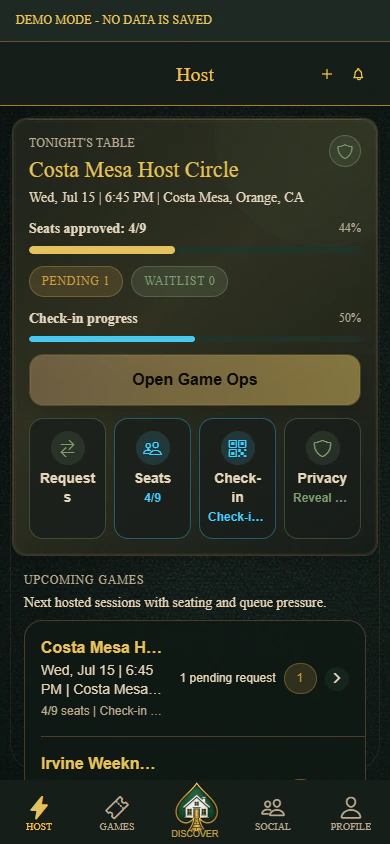
Hosting at home requires deliberate privacy controls.
One host concern shaped this feature: "Who can see my address right now?"
That is why PokerMeet is more than a scheduling tool. It includes access controls for private-home coordination.
Why Panic Hide exists
If a host feels uncomfortable at any point, they need immediate control, not a support ticket and not a delay.
What Panic Hide does
When a host triggers Panic Hide:
- Event visibility is removed for non-hosts.
- Address visibility is removed immediately for non-hosts.
- The host regains control and can decide what happens next.
Built for immediate control
We hope hosts never need to use Panic Hide. It exists so product access can close without waiting for a support response.
Panic Hide does not replace emergency services or host judgment. If there is an immediate threat, contact local emergency services first.
Ready to join PokerMeet?
See how PokerMeet protects location details
Players see the general area first. Exact address access requires host approval, safety checks, and active reveal timing.
PokerMeet shows the general area first, keeps host approval in the flow, and reveals exact addresses only after approval, safety checks, and active reveal timing.
Related notes
Keep reading the rollout and community-safety notes.
Safety and Privacy / Feb 10, 2026
How PokerMeet Protects a Host's Home Address
Learn how PokerMeet keeps exact home addresses out of public discovery and limits reveal to approved players when safety and timing conditions are satisfied.
Safety and Privacy / Feb 1, 2026
3 features we built to protect SoCal hosts
See how timed address reveal, Panic Hide, and reliability signals support host decisions for private home poker games.
About PokerMeet / Jan 21, 2026
What PokerMeet Is and Is Not
PokerMeet coordinates private home games. It does not conduct games, provide financial functionality, publish private addresses, or create an open guest list.